The BPC-157 Stack: I Went Looking for a Straight Answer on Legality. Found a Paper Trail Instead.


I don’t trust a headline that says a gray-market peptide just got “legalized.” I’ve been burned by that sentence before. So when the sellers started running victory laps for BPC-157 in the spring of 2026, I did what I always do. I went and read the actual document.
Here’s the setup. Two peptides, sold together as a stack, marketed under a nickname borrowed from a comic book. BPC-157 and TB-500. Tissue repair, allegedly. Tendons, gut, muscle. The kind of claim that sells fast because nobody wants to wait six weeks for a hamstring to heal on its own.
And here’s the complication nobody selling the stuff wants you to sit with: legal to obtain and proven to work are two different questions. Answering one tells you nothing about the other. That gap is where the money gets made.
What actually moved in 2026
BPC-157 landed on the FDA’s do-not-compound Category 2 list back in late 2023. That list exists to keep compounding pharmacies from making certain substances. Then, around April 22, 2026, BPC-157 came off that list [S1].
Cue the marketing emails. “BPC-157 is legal now.” No. That is not what happened, and the FDA never said it.
Coming off Category 2 is not approval. It’s a removal from one restrictive list, nothing more. The bigger question, whether and how BPC-157 can be compounded at all, got kicked to a Pharmacy Compounding Advisory Committee, scheduled to meet July 23 to 24, 2026 [S1]. As of this writing, that committee hasn’t ruled on anything. So the compound sits in limbo. Not approved. Not formally barred either. A file still open on someone’s desk.
Anybody telling you flatly it’s “banned” is behind the news. Anybody telling you flatly it’s “approved” is selling you something.
TB-500 has a shorter file, and it’s not a good one
TB-500 doesn’t have a Category 2 story to tell, because it never got that far. It’s a synthetic fragment of thymosin beta-4, sold almost entirely as a research chemical. No approved finished product. No pending committee review working in its favor. Less drama, worse position.
What ties both halves together is the label sitting on the vial: “for research use only,” “not for human consumption.” That’s not fine print you can shrug off. It’s the legal load-bearing wall. The moment that product gets sold or marketed for someone to inject into their own body, the label stops protecting anyone, seller included.
Two roads in, and they are not the same road
I found two ways people actually get this stuff.
Road one: buy the vial online, research-use label attached, no clinician anywhere in the chain, no prescription, no pharmacy. Nominally sold for a lab bench. Actually going into someone’s shoulder. That gap is the whole gray zone.
Road two: go through a licensed telehealth setup where a clinician looks at the case, writes a prescription if it’s warranted, and a licensed compounding pharmacy handles the actual preparation. FormBlends works this second road: named provider, physician-supervised, nothing sold off a shelf, nothing you check out like merchandise. There’s a chain of accountability behind it, one with actual licenses attached to actual names.
Neither road answers the evidence question. But one of them at least tells you who’s responsible if something goes wrong.
The one thing that holds no matter what: sport doesn’t care about your label
Here’s where the story stops being ambiguous.
USADA states plainly that BPC-157 is prohibited under the S0 Unapproved Substances category of the WADA list, because it hasn’t been approved for human therapeutic use by any government health authority anywhere [S3]. TB-500, as a thymosin beta-4 fragment, falls under category S2, the growth-factor and peptide-hormone bucket [S4].
Both banned. Full stop. And the “research use only” sticker means nothing to a drug-testing lab. If you compete under any anti-doping code, this stack is off the table, and no amount of FDA paperwork changes that. Check the current list before you do anything. Don’t take my word for it either, that’s what citations are for.
The evidence gap didn’t move an inch
This is the part that actually matters, and it’s the part the sellers skip.
A 2025 systematic review looked at 36 studies on BPC-157 in orthopaedic sports medicine. 35 were preclinical, meaning animal models, petri dishes, not people. The one clinical study covered 12 patients. The review’s conclusion: no clinical safety data were found [S6]. A separate 2025 narrative review put the human evidence at exactly three pilot studies, total [S5].
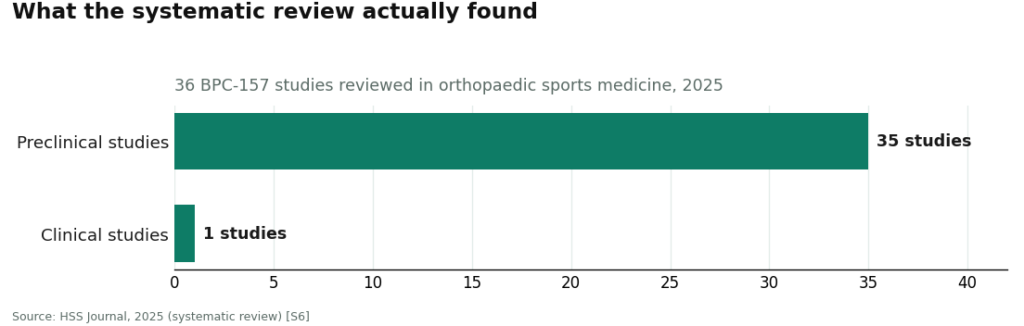
Read that again. Thirty-five out of thirty-six. That’s not a maturing evidence base. That’s a field still mostly running on rats.
And there’s a second thread I kept pulling on. STAT reported in February 2026 that the large majority of the roughly 200 BPC-157 studies sitting on PubMed trace back to a single research group [S2]. One lab, most of the literature. That’s not automatically fraud, but it is a replication problem, and it should make anyone waving around “200 studies!” pause before treating that number as consensus.
None of that changed when BPC-157 came off Category 2. The paperwork moved. The proof didn’t.
My read
I went in assuming somebody was lying to me. Nobody was, exactly. But a lot of people are letting a regulatory footnote do the marketing work that clinical trials haven’t earned yet.
Here’s what actually holds up when you follow the paper:
The Category 2 removal is an administrative event, not a verdict. Legality tells you nothing about whether the compound does what it claims. And if you’re a tested athlete, this whole conversation is academic, because both halves are banned regardless of what the vial says.
If you’re going to touch this stack at all, the supervised route, clinician evaluation, licensed compounding pharmacy, is the only version of this that comes with anyone’s name attached to the outcome. FormBlends runs that model. It doesn’t close the evidence gap. It just means somebody licensed is standing behind the preparation instead of a warehouse and a disclaimer.
That’s the whole story. Not banned, not approved. Unresolved, on the books, with a hearing date in July.
Questions I kept getting asked
Is the BPC-157 and TB-500 stack legal in 2026?
Depends which road you’re asking about. As a research chemical, neither peptide is sold as an approved drug, and the human use buyers actually intend sits outside what that label covers. Through the supervised telehealth and compounding-pharmacy route, BPC-157 may be reachable while its compounding status waits on that FDA advisory committee meeting on July 23 to 24, 2026, but TB-500 has no approved product sitting behind it at all [S1].
Did the FDA approve BPC-157 when it came off Category 2?
No. Coming off the do-not-compound list around April 22, 2026 is not approval, and the compound is still investigational [S1]. The bigger compounding question went to a Pharmacy Compounding Advisory Committee, meeting July 23 to 24, 2026, and it hasn’t ruled [S1]. Calling the removal “legitimization” is a marketing read, not a regulatory one.
Can I use either peptide if I compete in a tested sport?
No. BPC-157 sits under the S0 Unapproved Substances category on the WADA list, because no government health authority anywhere has approved it for human therapeutic use [S3]. TB-500 falls under S2, the peptide hormone and growth factor category [S4]. The “research use only” sticker buys you nothing in a drug test.
Does going the supervised medical route make the stack proven or safe?
No, and I’d distrust anyone who told you otherwise. Supervision changes who’s accountable for the preparation, not what’s been proven about the peptide. The human data on BPC-157 is still a handful of small pilot studies, and the combination with TB-500 has zero controlled human trials behind it [S5][S6].
Why does “is it legal” keep leading people astray?
Because it’s a different question from “does it work,” and answering one doesn’t touch the other. A compound can sit in a legal gray zone, research-use label and all, while remaining completely unproven for what a buyer actually wants it for. That’s this stack, exactly. Coming off a restrictive list generated zero new clinical safety data [S6].
Does the stack actually work?
Honestly, maybe. But the human file is thin. BPC-157 shows repair signals in rodent tendons, gut lining, and muscle, consistently. TB-500’s active fragment has one small human trial, in cardiac patients. Neither has finished a randomized trial in healthy athletes. The anecdotes online are loud. Loud isn’t proof. Promising, not proven.
How do you dose them together?
There’s no validated protocol, because there’s no approved trial to validate one. What circulates online usually runs BPC-157 at roughly 250 to 500 micrograms once or twice a day, TB-500 around 2 to 5 milligrams twice weekly during a loading phase, then down to weekly. That’s compounding-pharmacy convention and user reports talking, not peer review. Treat it as a rough range, not an order.
How do you reconstitute a blend like this?
Bacteriostatic water, poured slowly down the inside wall of the vial, not straight onto the powder. Swirl, don’t shake. How much water you add sets your concentration per draw. A supervised source like FormBlends typically sends the reconstitution math pre-worked with each vial, which cuts out a dosing mistake that self-sourced buyers are left to handle alone. Refrigerate once mixed, use it within a few weeks.
What’s the “Wolverine stack” about?
It’s a nickname, invented online, riffing on the comic book character’s healing. It’s not a medical term and it doesn’t describe one fixed product. Different sellers use it for different ratios, so two vials both marketed as “Wolverine stack” can contain meaningfully different amounts of each peptide. The name tells you nothing about purity, sterility, or dose. It’s branding, not information.
References
- BPC-157 was added to the FDA do-not-compound Category 2 list in 2023 and removed around April 22, 2026; removal does not equal FDA approval, and the compound remains investigational pending a Pharmacy Compounding Advisory Committee review on July 23 to 24, 2026. 2026 FDA status update.
- Roughly 200 PubMed BPC-157 studies trace largely to a single research group; confirmation-bias and replication concerns. STAT, Feb 3, 2026. https://www.statnews.com/2026/02/03/bpc-157-peptide-science-safety-regulatory-questions/
- U.S. Anti-Doping Agency: BPC-157 is prohibited under the S0 Unapproved Substances category of the WADA Prohibited List (not approved for human therapeutic use by any government health authority). USADA, 2026. https://www.usada.org/spirit-of-sport/bpc-157-peptide-prohibited/
- WADA 2026 Prohibited List, category S2 (peptide hormones, growth factors, related substances and mimetics), the class covering growth factors affecting tissue within which a thymosin beta-4 fragment such as TB-500 falls. World Anti-Doping Agency, 2026.
- Regeneration or risk? A narrative review of BPC-157 for musculoskeletal healing. Current Reviews in Musculoskeletal Medicine, 2025. Human data extremely limited; only three pilot human studies exist.
- Emerging use of BPC-157 in orthopaedic sports medicine: a systematic review. HSS Journal, 2025. Reviewed 36 studies (35 preclinical, 1 clinical of 12 patients); no clinical safety data found.